Taking new projectsBuild with Beyond, the studio of 11 Beyond

Custom software
and AI, built with you.

Bring us the problem that has outgrown spreadsheets and off-the-shelf tools. You see it working every week, and all of it is yours.

The first call is free.

Work for partners

5.0 out of 5 · Partner, via Upwork

“This project had two parts, each requiring different skills and conceptual orientation. Sarvesh completed them efficiently without the need for mid-course correction. He responded quickly to requests for changes in the deliverable as I revised my thinking on what would be the best form for it. I have used Upwork freelancers over what is close to a decade, and Sarvesh is up with the top ones.”

2,000companies, every layout

2,000 annual reports, no two alike, mapped into one supply chain.

The problem
Show where 2,000 listed companies really get what they need: their suppliers, where those suppliers are, and the suppliers behind them. An earlier attempt had stalled.
What we delivered
A pipeline that reads every 10-K whatever its layout and can be run again at any time, then an AI stage that works out who supplies whom, with HS and NAICS codes so results line up across companies.

supply-chain.runmade-up data

ACMR  10-K 2024  → json    done
ACMR  ← GLBX   wafers      TW
GLBX  ← ORLA   silicon     DE
silicon        HS 2804.61
GLBX           NAICS 334413
…
companies  2,000 / 2,000
5.0 out of 5 · Partner, via Upwork

Rated on Upwork, without a written review.

0IP addresses kept in readable form

Who opened the proposal files, without breaking GDPR.

The problem
A firm in Paris sends proposal packs through a file-sharing tool and wanted to know which files were opened, how often, and by how many people. The tool’s own API gave nothing.
What we delivered
We worked from the firm’s own server logs instead. Each visitor became a one-way, pseudonymous ID, so no IP address is ever shown or kept in readable form. The result is a dashboard in the firm’s own branding.

opens.dashboardmade-up data

file          dl  views  unique
proposal.pdf   4      9       3
pricing.xlsx   2      3       2
cases.pdf      1      5       2
terms.pdf      0      2       1
visitor a41f  opened 3 files
4.9 out of 5 · Repeat partner, via Upwork

“This is one of a number of projects I have done with Sarvesh, and hope to continue to work with him going forward. He has very good skills to get things done in a wide set of areas.”

15–25articles a day from each publication

A daily news digest from his own subscriptions, and AI that answers from it.

The problem
A finance professional, not a developer, wanted the markets coverage of several paid publications summarised and tagged every day, through his own logged-in subscriptions.
What we delivered
A pipeline on his own computer that reads each publication the way he does and saves tagged summaries. On top of it, he asks a question in plain English and gets an answer drawn from everything saved, with the articles it came from.

digest.askmade-up data

{
  "title": "Rates held, for now",
  "date": "2025-06-12",
  "tags": ["Fed policy", "inflation"]
}
› What changed on rates this week?
Held for now; two of three pieces
expect a cut by autumn. [1] [3]
5.0 out of 5 · Partner, via Upwork

“Incredible developer. Highly recommend to anyone needing any analytical services. Responsive and provides high quality work.”

AnyUS ticker, from the SEC’s own filings

Insider trades for any US-listed company, in one clean table.

The problem
A community site wanted to show who is buying and selling shares at any US-listed company, straight from the SEC’s own records and quick to drop onto a company page.
What we delivered
A script that turns the SEC’s insider filings for any ticker into one table: who traded, how many shares, the value and the date.

insiders.tablemade-up data

insider     side  shares  value  date
Director A  sell  12,000  $2.1M  Aug 02
Officer B   buy    3,500  $610K  Jul 19
Director C  sell   8,250  $1.4M  Jul 03
total held  1.2M shares

Described, not linked: a partner’s work belongs to the partner. The reviews are their own words.Read them on Upwork

Most software projects disappoint. Here is what we do about it.

What research found about software projects, and what we do about each
Where it goes wrongTypical projectsWith us
The budget45% over budget1A fixed quote, agreed first
The value56% less value than planned1Working software every week
The outcomeOnly 31% succeed2Signed off one round at a time
The requirementsBehind 47% of failed projects3A written brief, then a plan you agree
The communicationSinks 1 in 5 projects4You talk to the people who build it

Sources: 1 McKinsey and the University of Oxford, large IT projects (2012). 2 The Standish Group’s CHAOS report (2020), in ACM Queue. 3 PMI, Pulse of the Profession (2014). 4 PMI, The High Cost of Low Performance (2013).

The hardest problem in a notes app is capture. Brainby is our answer.

A thought turns up mid-walk or mid-meeting. If keeping it means opening an app, choosing a list and typing, it is gone before you finish. So in Brainby, our own app, keeping one takes under two seconds.

Meet Brainby Coming soon to iPhone

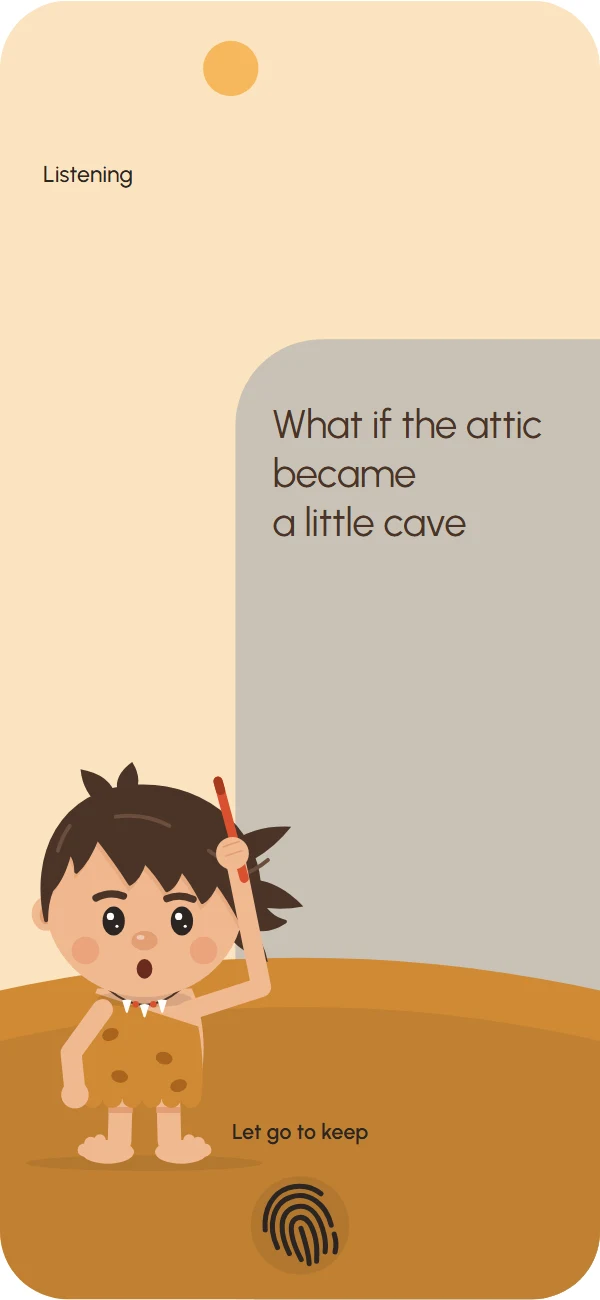
  1. Brainby listening: the words “What if the attic became a little cave” appear on a stone as they are said, with “Let go to keep” above the fingerprint button.
    01

    Hold and talk

    One button, on every screen. Nothing to choose first.

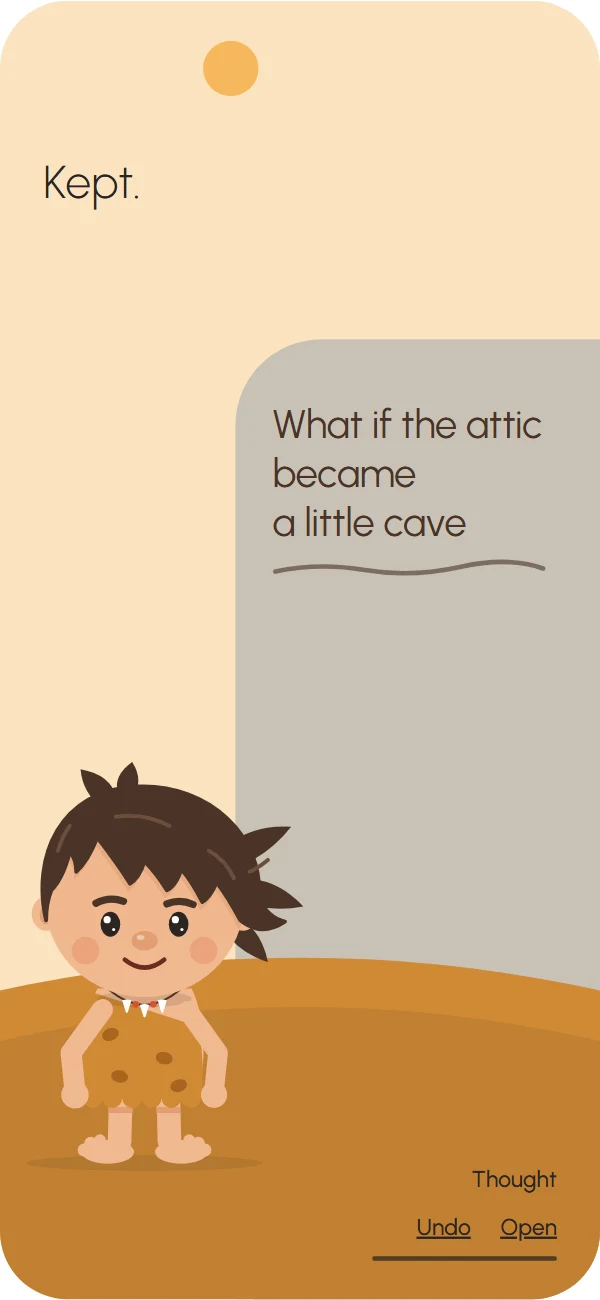
  2. Brainby after letting go: “Kept.”, the same words underlined on the stone, filed as a Thought, with Undo and Open.
    02

    Let go. Kept.

    Saved on the phone the moment you stop, so nothing is lost.

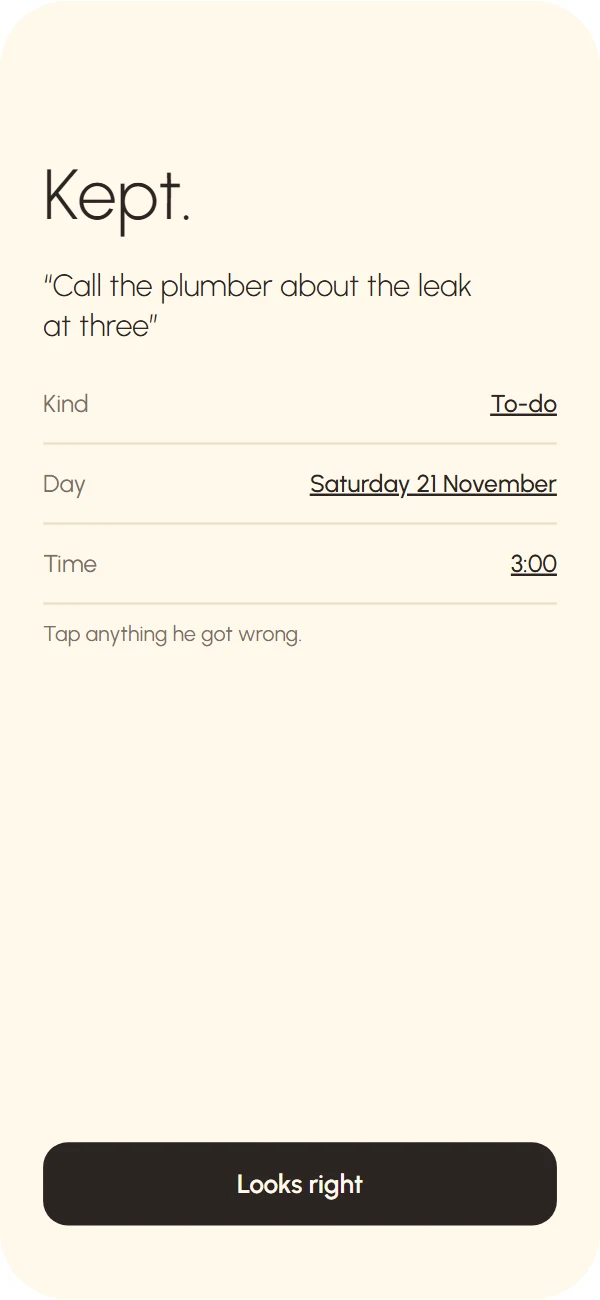
  3. Brainby showing what it understood: “Call the plumber about the leak at three” as a To-do, with its day and time, and the line “Tap anything he got wrong.”
    03

    Filed for you

    It works out the kind, the day and the time. One tap fixes a miss.

  • 46.9%of waking hours, the mind is on something else1
  • 40%of days, adults report a memory lapse2
  • 4things, on average, a mind holds at once3
  • 3×faster to say a thought than type it on a phone4

Sources: 1 Killingsworth and Gilbert, Science (2010), 2,250 people sampled through the day. 2 BMC Geriatrics (2023), 2,018 adults aged 25 to 91 over eight days. 3 Cowan, Behavioral and Brain Sciences (2001). 4 Ruan, Landay and others, Stanford University (2016), speech against the iPhone keyboard.

We find the real problem. Then we build the simplest thing that solves it.

Five stages. You always know which one you are in.

  1. 01

    Spark

    A free call.A written brief

  2. 02

    Blueprint

    We plan it with you.A plan and a fixed quote

  3. 03

    Build

    Short rounds.Working software every week

  4. 04

    Refine

    Real data, real use.Fixed before your people find it

  5. 05

    Beyond

    Launch, and after.Support, one message away

Every project gets a private space, Orbit, with the stage we are in, a written update every week, the files and the invoices.

No agency layers. Six things in writing instead.

  • A fixed quote

    Agreed before anything is built.

  • No surprise bills

    Extra work is priced and agreed in writing first.

  • It is yours

    Code, designs and documents, as each invoice is paid.

  • 4 to 7 days of fixes

    After every release, at no charge.

  • You can stop

    Seven days’ notice, and you keep everything made so far.

  • It stays private

    Never used to train AI. Never shown without your written yes.

Priced for your problem. Fixed before we start.

  • The first call

    Free

    You leave with a written brief.

  • Blueprint

    Free or priced

    You know which before it begins.

  • The quote

    Fixed

    Agreed before any building starts.

  • Paying

    In stages

    In US dollars or your own currency.

Documents to turn into data? That package has its own page.

See Document automation

Founder-led. Personally involved. Built with care to go Beyond.

Sarvesh Khandelwal

Sarvesh Khandelwal

Founder, 11 Beyond. Sarvesh founded the studio and sets the bar for every project we take on. We build our own products too, Brainby and GemConnect, so the care your project gets is the care we give our own.

What partners ask before they write.

How is the price set, and how do I pay?

Each project is priced for its problem: how complex it is, how long it takes and what it connects to. At the end of Blueprint you get a plan and a fixed quote that describes the scope, before any building starts. Payments follow the schedule in the quote, in US dollars or your own currency, and the quote says whether taxes are included; each invoice appears in your orbit and by email, with its due date and a way to pay.

Is Blueprint free?

Sometimes. When the way to solve the problem is clear, Blueprint is free. When finding it takes real work (research, prototypes, a technical plan), Blueprint is priced on its own. Either way, we tell you which, and the price, before it begins, and the first call is always free.

What if the plan changes along the way?

That’s welcome. Anything outside the quoted scope is agreed in writing before we build it, with its price and the time it adds. Nothing is billed that you haven’t agreed to.

Who owns the code and the designs?

You do. As each invoice is paid, the work it covers that we made for you (designs, code, documents and content) becomes yours, worldwide and for good, and what you bring stays yours throughout. Tools and libraries we bring to every project stay ours, and you get a permanent licence to use and change them as part of what we built for you. Open-source parts keep their own licences.

Do you use AI to build?

Yes, where it helps: to research, build, test and document. A person on our team reviews the work, and we stay responsible for what we deliver. We never use what you share to train AI models, and we only put it through services that don’t train on it.

Will what I tell you stay private?

Yes. What you tell us about your business stays between us, during the project and after it, and we use it only for your project. Either side may share only what’s already public, or what the law requires. We name or show your project in our own work only with your written yes.

What happens after launch?

For 4 to 7 days after a release (the quote says which), we fix any defect at no charge: something we built that doesn’t do what the agreed scope says it should. New features and changes of mind are quoted separately. Support and improvements after that are agreed separately too, usually in Beyond, the fifth stage.

Where are you based, and can we talk in our working hours?

We are in Jaipur, India, as 11 Beyond Solutions Private Limited, and we work with partners wherever they are. We take calls at a time that suits you: the booking page shows every time in yours, and if none of them suit you, write to us and we’ll find one. Between calls, everything is written in your orbit, so nothing waits on a time zone.

Can either of us stop partway?

Yes, with seven days’ written notice. You pay for the work done up to that day, and for any costs we’ve already committed to on your behalf that can’t be cancelled. Once that’s paid, we hand over everything made so far, in a form you can use, and it’s yours.

Tell us what you need solved. The first call is free.

Pick a time that suits you. You leave with a written brief of what we heard, whether or not we work together.

We take calls at a time that suits you, wherever you are in the world.

Or email contact@elevenbeyond.com

  1. A call or a note to start
  2. We reply within one working day
  3. A written brief you can correct
  4. A plan and a fixed quote

Write to us. We reply within one working day.